
Ellis County Criminal History Checks
Start with the record that answers the question. The Ellis County LGS index is the first stop for a filed felony or Class A or B misdemeanor. The Wayne McCollum Detention Center answers current custody questions. An arrest or incident narrative remains with the sheriff or the city police department that made the arrest. Texas DPS supplies a statewide public conviction and deferred-adjudication product, while its fingerprint process is the stronger match for reviewing one’s own Texas history.
Names alone can create false matches. Gather the full name, spelling variants, date of birth when an official form permits it, approximate event date, arresting agency, and any cause or booking number. Then work through the layers in order:
- Identify whether the event is an arrest, booking, filed case, statewide history, warrant, or custody record.
- Search the correct local court tier or current Ellis County jail channel.
- Match the result by cause number, dates, court, and other public descriptors rather than name alone.
- Ask the arresting agency or clerk for the public source document when the index lacks detail.
- Use certified clerk copies or fingerprint personal review when identity and accuracy matter.
Following One Ellis County Arrest
One event can create four distinct Ellis County records. The arresting agency writes an incident and arrest report. Jail staff create booking, identity, bond, property, and custody entries. A prosecutor may then file a charge that produces a clerk cause file. Fingerprints and later disposition data travel to the Texas DPS Computerized Criminal History system. The records relate to one another, but none is a substitute for all the others.
| Record layer | Best answer | Key limit |
|---|---|---|
| Agency report | What officers alleged or documented | Does not establish guilt |
| Jail booking | Intake, custody, charge, and bond at that time | The charge can change |
| Clerk case | Filed charge, docket, judgment, and sentence | Not a statewide identity history |
| DPS history | Reported Texas arrest and disposition cycle | Public view is only a releasable subset |
A recent booking may exist before a prosecutor files a case. A dismissal can remain in a local index unless legal relief changes access. Delayed or mismatched disposition reporting can also leave the DPS cycle incomplete.
For a recent event, the Ellis County arrest search route starts with the arresting agency and current jail custody before the filed court cause exists.
Official Background Checks in Texas
The Texas DPS Crime Records Service public site lets a public user run a name search for conviction and deferred-adjudication information that Chapter 411 permits DPS to release. Search credits cost $1, and opening a full result consumes one credit. A card purchase adds 2.25 percent per credit plus $0.25 per order. An offline DPS name check costs $10. Similar names, a wrong birth date, and missing disposition data can all affect a result.
The official DPS search interface shows why an account and credits form part of the process.
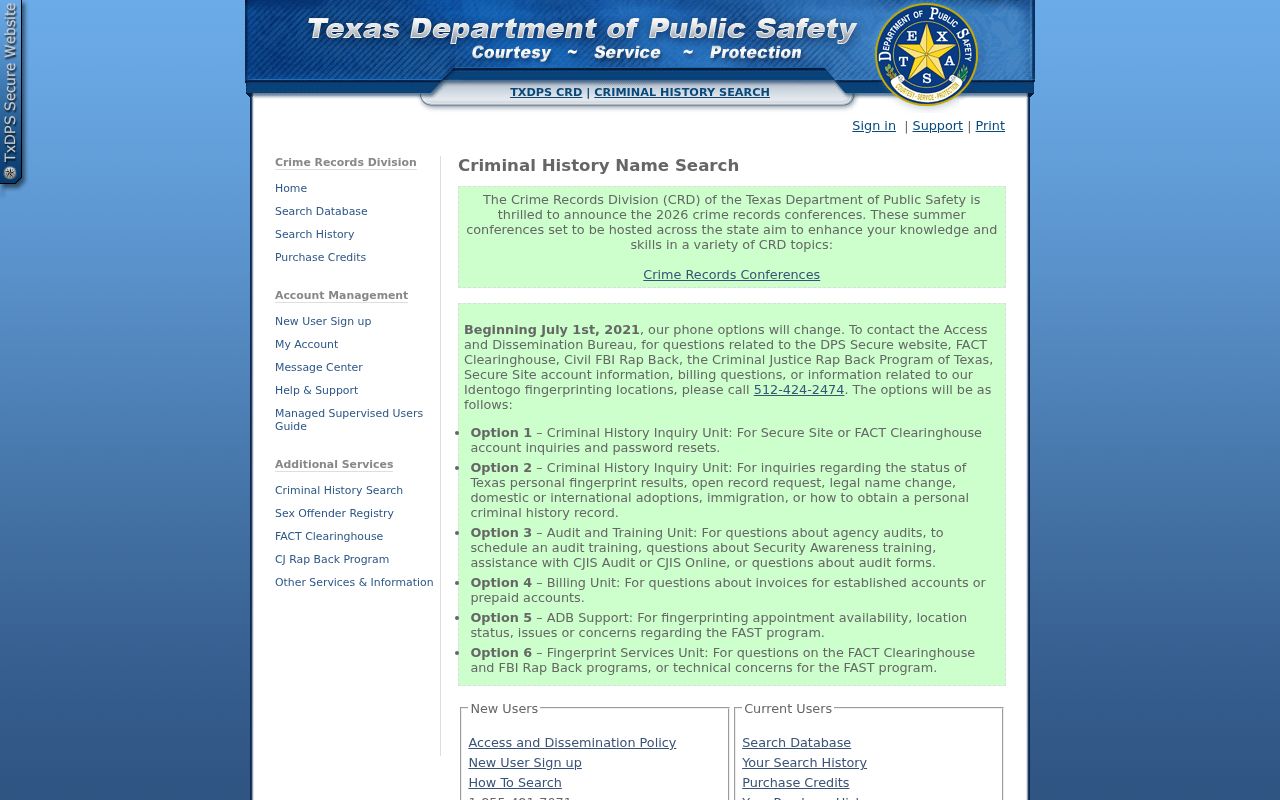
The screen is a statewide public-data route, not an Ellis County clerk docket or a fingerprint identity match.
For a person reviewing their own Texas repository record, DPS directs fingerprint capture through FAST, the Fingerprint Applicant Services of Texas program, using IdentoGO by IDEMIA. DPS guidance lists a $15 DPS fee and $10 FAST capture fee for personal review, though the service code and appointment govern the actual enrollment. The FBI Identity History Summary is a separate subject-only federal product with an $18 FBI fee before any capture or channeler costs.
Ellis County LGS Record Controls
The Ellis County Clerk links the LGS Online Records Search for Ellis County case indexes. Select Ellis County and a court-record office or category, then use a party name or cause number. A cause number is the cleanest locator. With a name search, use the first name to narrow a common surname and treat the filing range as a filing date, not an assumed offense date.
| Control | Type | Use |
|---|---|---|
| County | Dropdown | Select Ellis when the landing page serves more than one county |
| Record or department | Dropdown or tiles | Choose court records, then the correct clerk office |
| Search type | Tabs or dropdown | Choose party name or cause number |
| Last or Business Name | Text | Required for a name route; spelling changes matter |
| First Name | Text | Narrows the result list |
| Case or Cause Number | Text | Best exact locator; format may matter |
| Date range | Date fields | Optional filing-range filter |
Guest access provides free index information and image preview. Registered users can buy public images through the cart. LGS imposes a $0.30 transaction fee, and a subscription is required after five court or property images. Some details and images remain unavailable online, so the clerk is the final source for a public or certified file.
Kinds of Criminal Records
Ellis County criminal records differ by creator and purpose. Incident reports contain an agency narrative. Arrest reports address the claimed basis and facts of custody. Jail records document intake. Magistrate and bond records can arise before the filed case. The court file then tracks the charge chosen by the prosecutor and the court’s result. A warrant belongs to its issuing cause, while a sex-offender registry entry follows a separate statutory system.
- Booking record
- The jail’s intake record, with custody, initial charges, bond, property, photo, and fingerprints as applicable.
- Cause file
- The clerk-held court record containing filed documents, docket events, orders, judgment, costs, and sentence.
- Disposition
- The outcome of the filed charge, such as dismissal, acquittal, deferred adjudication, or conviction.
- Capias
- A court command to take a person into custody in connection with an existing cause.
- Nondisclosure
- A Texas order that restricts ordinary public disclosure without destroying every government-held record.
Police reports remain with the sheriff or city department that created them. Ellis County does not pool every city narrative into one sheriff file. Adult community supervision is administered by Ellis County CSCD, while the Texas Board of Pardons and Paroles makes release decisions and the TDCJ Parole Division supervises releasees. Public court and locator entries do not open day-to-day supervision notes.
The Texas Public Sex Offender Registry is another separate record system. City police register residents within municipalities, while the Ellis County sheriff serves its statutory area outside them. A registry profile is not a general criminal-history report and must be used lawfully.
Juvenile information is generally confidential. Federal cases use PACER, and federal custody uses the Bureau of Prisons locator. Neither record is automatically copied into the Ellis County clerk index.
DPS Names Versus Fingerprint Records
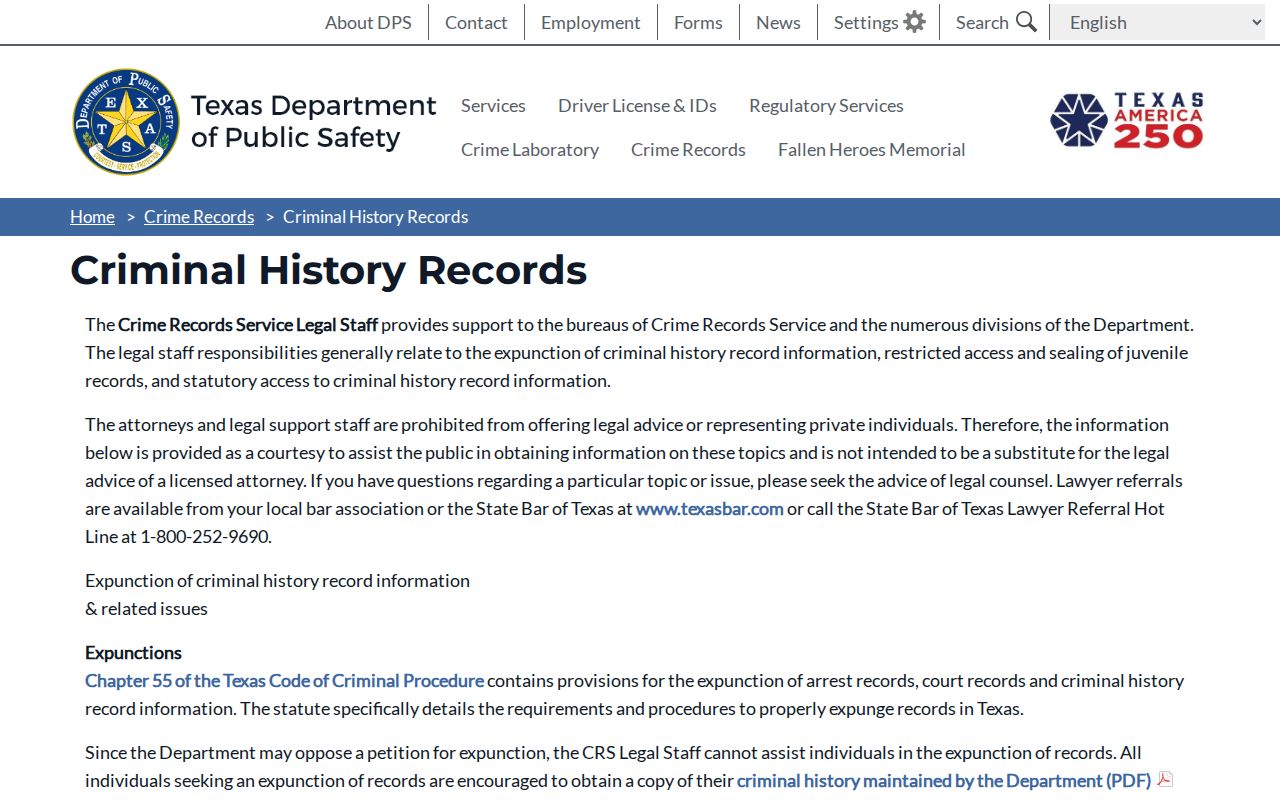
A public DPS name result is a lead. It is not proof that the record belongs to the person of interest. The search uses names, dates, and other descriptors, while fingerprint personal review ties the request to biometric identity. Texas DPS criminal-history guidance explains the available products and their limits.
The DPS records guidance also illustrates the distinction between a public conviction search and controlled criminal-history information.
For an error, first locate its source. A wrong clerk judgment field must be fixed with the clerk, an agency submission with the reporting agency, and a repository mismatch through DPS error resolution. Correction makes a record accurate. It does not expunge an accurate event.
Ellis County Criminal Records: What They Contain
A full Texas repository cycle can associate identity descriptors and fingerprints with an arresting agency, arrest date, tracking number, offense code, prosecuting office, cause number, filed charge, disposition, and sentence. A public DPS return suppresses fields that Texas law does not permit DPS to disseminate. An Ellis County clerk file focuses on the local case rather than the full statewide person history.
| Name & identifiers | Legal name, aliases, birth data, physical descriptors, and repository identifiers when the product permits them |
|---|---|
| Arrest / booking data | Agency, date, tracking or book-in number, initial charge, custody, and bond fields |
| Charges & statutes | Offense descriptions, codes, degree, filed charge, and court |
| Disposition | Dismissal, acquittal, deferred adjudication, conviction, or another reported result |
| Sentence | Confinement, fine, costs, or community-supervision terms when reported |
| Limits | Restricted data, delayed dispositions, unmatched cycles, and events outside the source’s coverage |
Always compare the filed charging paper and signed judgment. A booking label may differ from the prosecutor’s charge, and a short docket code may not convey the whole result.
Ellis County Custody Record Paths
The Wayne McCollum Detention Center roster is for current local custody, including people awaiting a case outcome and some short local sentences. Jail information is available at 972-825-4931. Once a person transfers to state custody, use the TDCJ Online Inmate Search. Federal custody belongs in the BOP system. These tools answer location and status questions, not whether the underlying charge ended in conviction.
The Federal Bureau of Prisons inmate locator shows the separate federal search route.
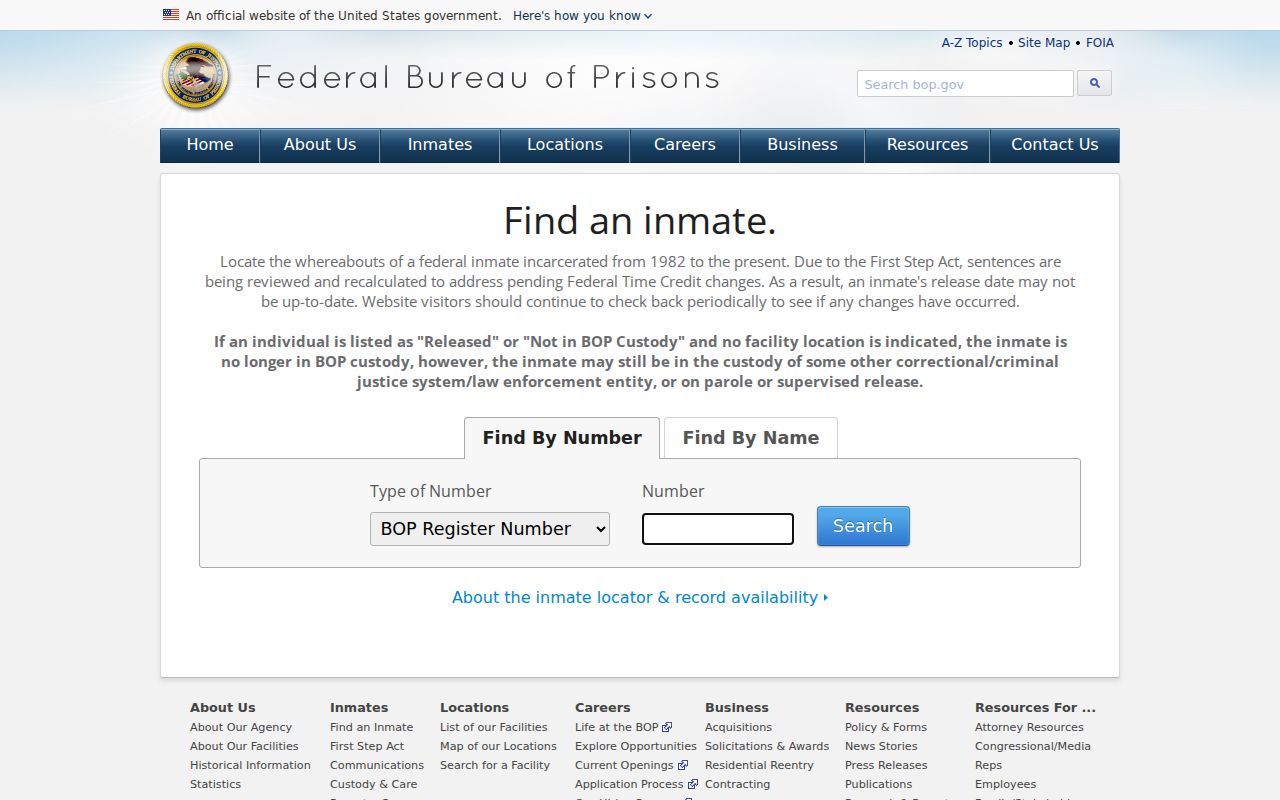
A result marked released or not in BOP custody does not rule out Ellis County jail or Texas state custody. Search the system that matches the custodial authority.
Texas Public Access Laws
The Texas Public Information Act applies to records held by the sheriff and city police, but judicial case records use court access law and local clerk procedure. The distinction matters. A request for an incident narrative goes to the agency’s designated TPIA channel. A complaint, indictment, docket, or judgment goes to the appropriate Ellis County clerk.
Key statutes:
Government Code Chapter 552 creates the public-information framework and preserves basic arrest information subject to other confidentiality laws.
Government Code Chapter 411 limits criminal-history dissemination and governs nondisclosure.
Code of Criminal Procedure Chapter 55A controls expunction.
Family Code Chapter 58 restricts juvenile justice information.
Law-enforcement exceptions, protected victim data, medical details, and security-sensitive material can be withheld or redacted. An index that is open to search does not mean every underlying image is public online.
No Ellis County Warrant Portal
No official countywide public warrant-search portal was confirmed. Search the underlying LGS cause, then call the issuing clerk. Sheriff dispatch at 972-937-6060 or administration at 972-825-4901 can route a warrant question, while municipal and justice-court warrants stay with the court that issued them. A written sheriff request can seek releasable warrant information, though sealed and protected matters may not be disclosed.
A person resolving their own warrant should speak with the issuing court or counsel about appearance, bond, and clearance. Do not rely on a stale list or assume a payment updates status at once. Arrest warrants, a capias in a pending cause, and a capias pro fine after judgment are different court commands.
Note: A phone response is a routing aid, not a certified statement that no active warrant exists.
Restricted, Sealed & Expunged Records
Ellis County juvenile files, protected victim data, grand-jury material, sealed warrants, nonpublic DPS history, and operational parole files do not become public merely because a broad records search exists. Expunction under Chapter 55A can remove or destroy eligible records across named custodians. An order of nondisclosure instead blocks ordinary public disclosure while leaving access for authorized agencies named by Texas law.
Eligibility depends on the whole arrest episode, its charge history, the result, statutory exclusions, and timing. A dismissal alone is not an expunction order. Ellis County assigns mandatory-jurisdiction expunction and nondisclosure matters to the 443rd District Court. Petitioners must identify each custodian, such as the arresting agency, jail, prosecutor, clerks, and DPS, so notice and any final order reach the correct files.
Ellis County Fingerprint Record Review
The FAST enrollment gateway begins with the service code supplied by DPS or another authorized program. The user selects an appointment, presents the required identity documents, and completes fingerprint capture. The code affects the service and fee, so a generic appointment page should not be read as one fixed local price or a promise of walk-in service.
The official FAST enrollment screen is the start for a fingerprint-based Texas record path.
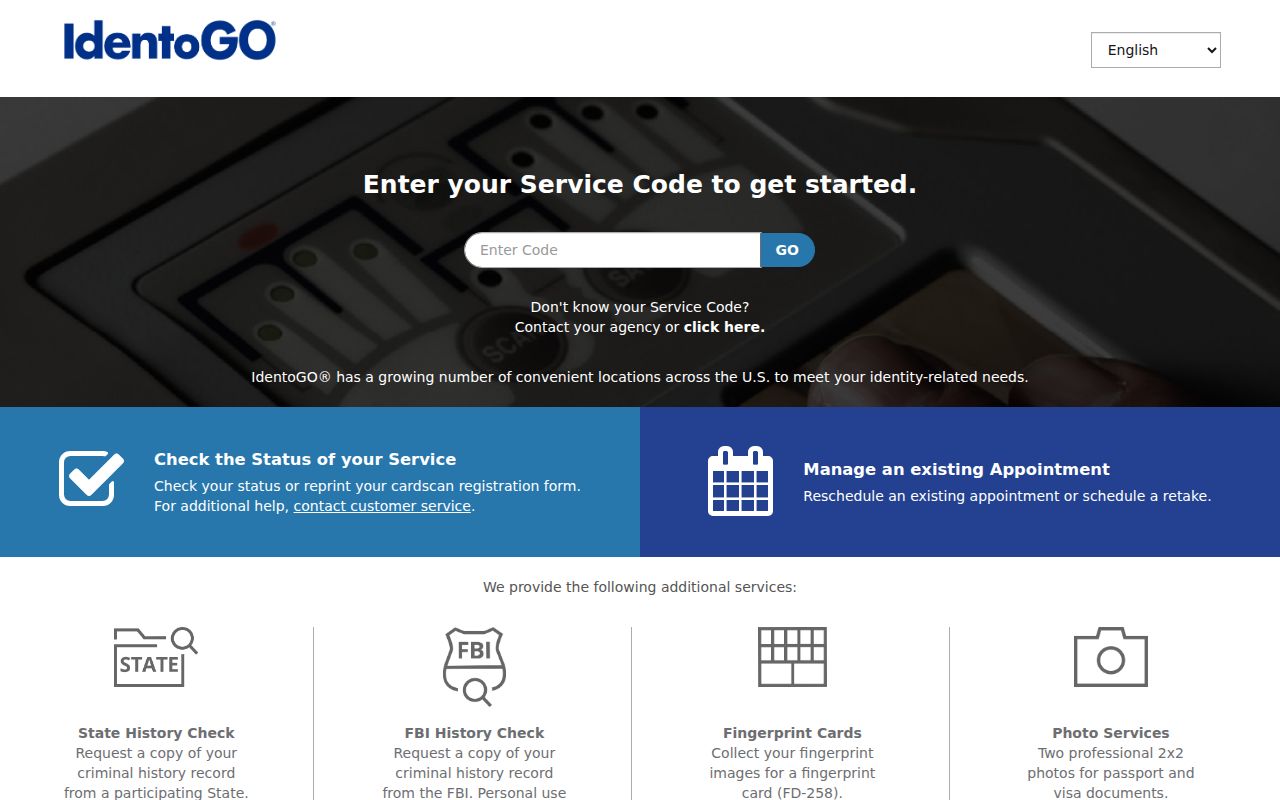
Fingerprint review is most useful for checking one’s own repository cycle, challenging a mismatch, or confirming whether the disposition returned to DPS. It does not replace the Ellis County clerk when a certified local judgment is required.
Ellis County Record Counter Routing
Current court work is centered at the Courts & Administration Building, 109 South Jackson Street in Waxahachie, as the official Ellis County site directs, not the historic courthouse on the square. The District Clerk holds felony case files. The Ellis County Clerk Criminal Division handles Class A and B misdemeanor files and can be reached at 972-825-5062. The public counter generally runs 8:00 a.m. to 4:30 p.m. Jail records and bond or release questions belong at 300 South Jackson Street.
District Clerk
109 S. Jackson St.
Waxahachie, TX 75165
972-825-5091 verify current line
Felony district case files
Ellis County Clerk Criminal Division
109 S. Jackson St.
Waxahachie, TX 75165
972-825-5062
Class A and B misdemeanor files
Wayne McCollum Detention Center
300 S. Jackson St.
Waxahachie, TX 75165
972-825-4931
Current custody, bond, and release
Ellis County’s history of the 1897 courthouse confirms its landmark role, but it is not the default criminal-record counter. That routing point prevents a common trip to the wrong building.
Ellis County Diversion Record Outcomes
Ellis County’s misdemeanor Pretrial Intervention Program covers specified nonviolent offenses for eligible people ages 17 through 24 when the offense occurred on or after September 1, 2022. The program costs $60 per month, plus any applicable restitution and program charges, and may last up to 12 months. Successful completion leads to dismissal. The materials contemplate a one-year agreed delay before an expunction request.
The felony PIP is a distinct prosecutor-controlled option for specified nonviolent state-jail-felony drug offenses occurring from January 1, 2019, subject to its own age and history limits. Neither program completion nor dismissal erases a record by itself. The court file must be read for the actual outcome, and a separate Chapter 55A order is needed when expunction is available.
Ellis County and Federal Case Records
Ellis County falls within the Dallas Division of the U.S. District Court for the Northern District of Texas. Federal case dockets use PACER, not LGS. Through December 31, 2026, PACER charges $0.10 per page, usually capped at $3 for a case-specific document or report, and waives quarterly charges of $30 or less. Opinions and courthouse-terminal access are free.
The official PACER gateway marks the line between county and federal court records.
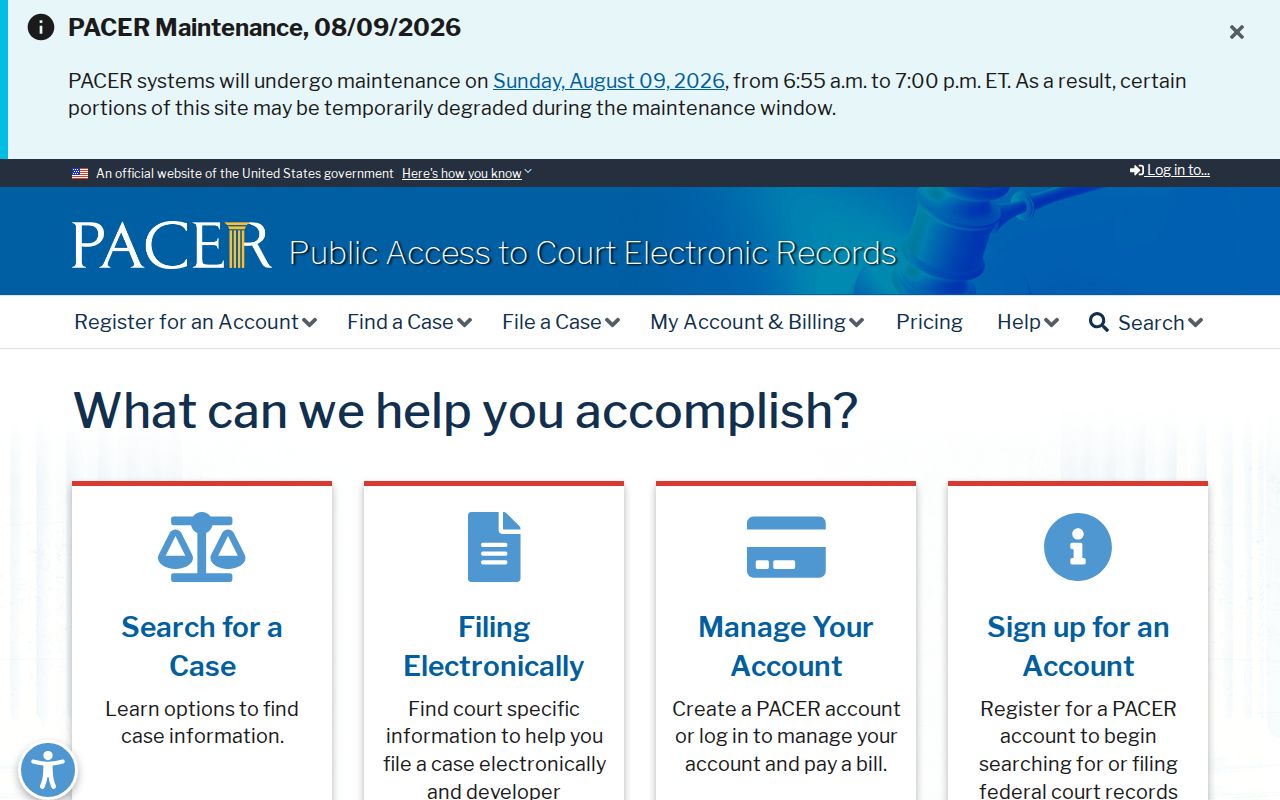
A PACER docket, an FBI Identity History Summary, and a BOP custody record answer three different federal questions. None should be treated as an Ellis County criminal case index.
City-by-City Criminal Records in Ellis County
City police departments keep their own incident and arrest narratives, while municipal courts retain fine-only city cases. The county jail and Ellis County clerks enter the chain when custody or higher charges move beyond the city level. The three largest incorporated cities therefore have distinct starting points.
Waxahachie Record Check
WPD holds its reports, the city court holds Class C matters, and the county jail is within Waxahachie.
Midlothian Record Check
Police Records and the city jail share the public-safety facility before any Ellis County transfer.
Red Oak Record Check
Police records, a separate 24-hour holding facility, and city court each hold a different record slice.
For charges that reach prosecution, the Ellis County court case lookup shows which clerk and court hold the filed case.